Interior demolition and strip-out works
Bathroom cores, partition walls, an opening in a load-bearing wall, floors, ceilings. Work that is not done with an excavator but by hand, piece by piece, with regard for what stays standing around it.
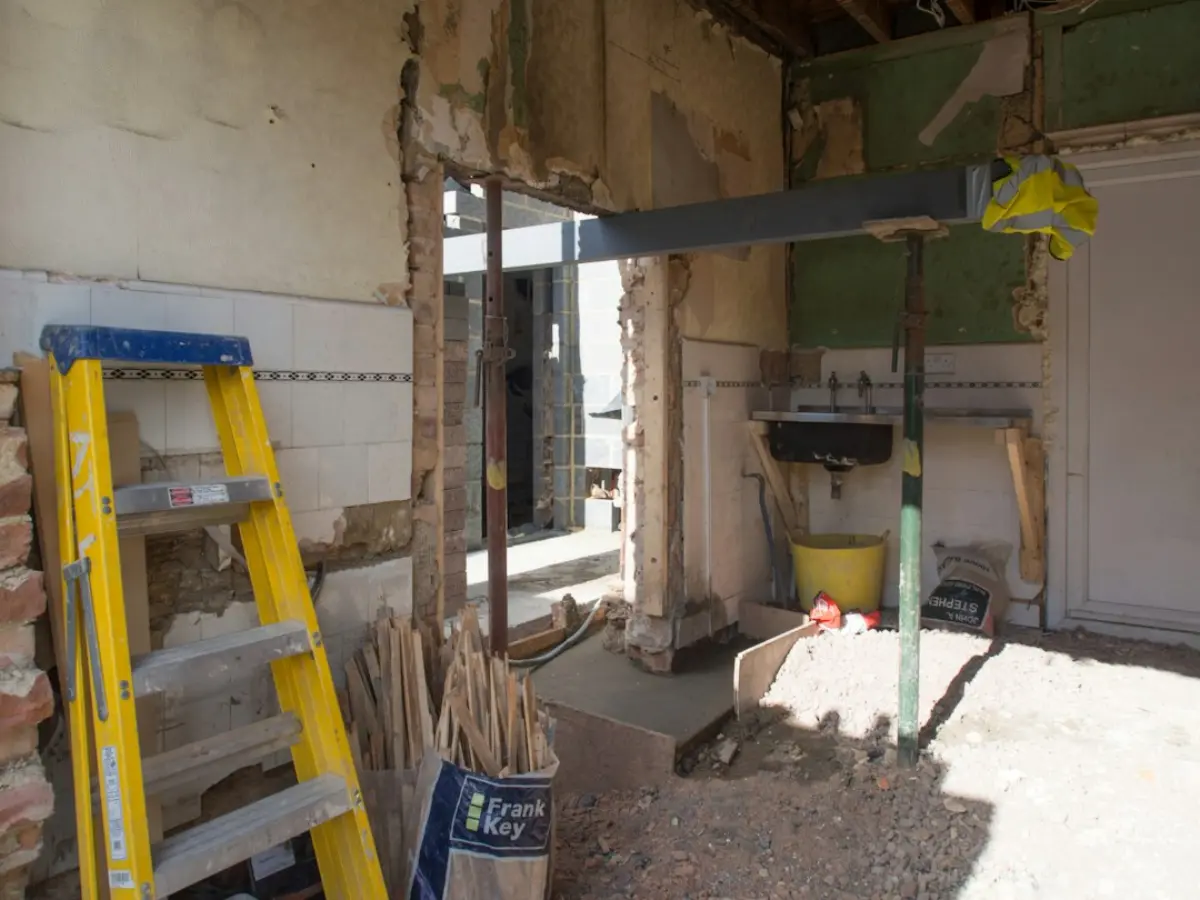
When work is done by hand
Demolition by hand is not used because it is better, but because machinery has no way in, or would do more damage than work. Typically in a flat on the third floor, in a building where the rest is staying, or where a neighbouring structure has to be preserved.
- Bathroom core. Both the lightweight panel type and the masonry one. In panel blocks you need to know whether the core carries anything and where the risers run.
- Partition walls. Non-load-bearing walls come out fairly easily. What matters is finding out what runs inside them: wiring, water, ventilation.
- An opening in a load-bearing wall. First a structural engineer and a lintel design, only then demolition. A load-bearing wall is not opened by eye.
- Floors and suspended ceilings. Concrete screeds, old cinder fill, plasterboard. The volume of waste is usually larger than people expect.
- Tiles, paving and plaster. Preparation for a renovation, most often in bathrooms and kitchens.
- Removing windows, doors and frames. Including making good the reveals.
What is easy to forget in a flat or a house
| Item | Why it matters |
|---|---|
| Load-bearing versus non-load-bearing wall | Not even a doorway is cut into a load-bearing wall without a structural assessment. Panel blocks have more load-bearing walls than they appear to. |
| Consent of the owner or the building association | In a flat, work affecting the structure or shared services is a matter for the owners association, not just the flat owner. |
| Services inside the walls | Wiring, water, gas, waste. Disconnect and cap them before demolition, not during it. |
| Dust and protecting the surroundings | Sheeting, extraction, protecting the lift and the hallway. Neighbours remember this for a long time. |
| Carrying the rubble out | From upper floors by lift (not always allowed) or down the stairs. This is often dearer than the demolition itself. |
| Noise and working hours | House rules and municipal by-laws usually limit when work can be done. Check in advance. |
Frequently asked questions about strip-out works
How are hand demolition works charged?
Most often by the hour and the number of people; for larger jobs by volume or area. What matters is whether carrying out and hauling the rubble is included. Ask before you sign: in a flat on an upper floor it is a substantial part.
Can I take out a partition wall without a permit?
Work on a non-load-bearing partition is simpler than on a structural wall, but the rules depend on whether it is a flat or a house and on what is being changed. In a flat the owners association is involved as well. Ask us and we will check it for the specific address rather than letting you demolish at your own risk.
Do you also handle the clean-up?
Yes, a rough clean-up and debris removal belong to the job. Agree in advance whether the space is to be handed over swept or ready for the next trades.
Related pages
Tell us what needs to come down
The address, a few photos and one sentence about what has to go is enough. We go through the enquiry and pass it to a demolition company that works in your area. If we have no partner there, we say so straight away instead of leaving you waiting.
- Photos from outside and inside say more than a description. A phone camera is fine.
- Tell us whether machinery can reach the building, or whether it has to come down by hand.
- If you suspect asbestos (corrugated cement sheets, old pipe lagging), say so right away.
Prefer the phone? 775 654 443.