Demolition of houses and structures
Demolishing a family house is three quarters organisation and one quarter knocking things down. First the permit and disconnected utilities, then the excavator, and finally the hauled-away rubble and a levelled plot.
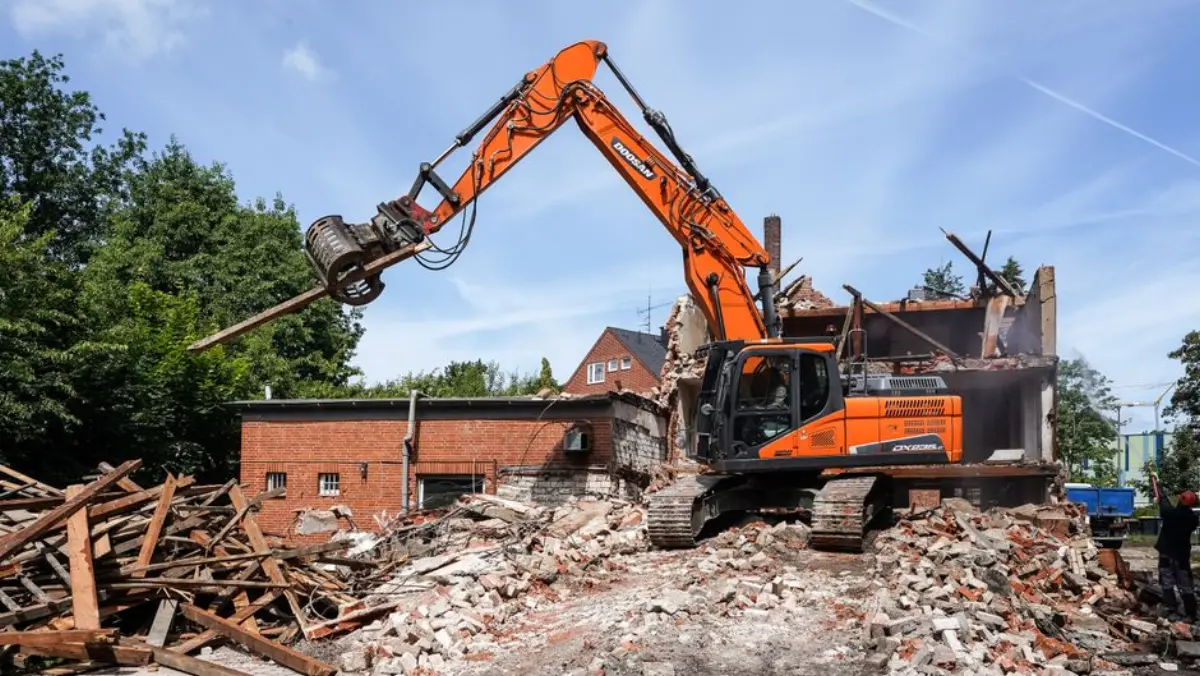
What actually happens during a house demolition
The order of steps is almost the same for a family house, a cottage or a farm building, and it can be written down in advance.
- Site visit and survey. The volume, the type of floor structures, the depth of the cellar, the material of the load-bearing walls and, above all, whether machinery and a skip can reach the building.
- Permit and documentation. A structure that itself needed a permit usually needs a permit for removal. The demolition documentation is prepared by a qualified designer.
- Disconnecting the utilities. Electricity, gas, water, sewerage. Each operator separately. This is usually the longest part.
- Clearing the building. Furniture, appliances, fittings. They are not demolition waste and are paid for differently.
- Removing hazardous and non-recyclable parts. Cement sheeting, insulation, oil tanks. Asbestos has its own regime.
- Machine demolition. An excavator with shears or a breaker; the structure is sprayed with water as it goes to keep the dust down.
- Sorting and haulage. Brick, concrete, steel, timber and mixed waste leave separately. Sorted rubble is cheaper to dispose of.
- Foundations and ground. Breaking out the foundations, backfilling, compacting and levelling. This is the item quotes miss most often.
What gets demolished most often
| Type of building | What to watch out for |
|---|---|
| Family house or cottage | The cellar and foundations make up a large share of the volume even when there is only a ground floor and a loft above. |
| Terraced house or half of a semi | The neighbouring wall stays standing. It has to be secured, insulated and agreed with the neighbour in writing. |
| Farm building, barn, shed | Often with cement sheet roofing. That is a reason for care, not for panic, but it is dealt with separately. |
| Garage, extension, walls, hard standings | Smaller in scale, same question: where does the concrete go and who issues the waste transfer document. |
| Part of a building during a renovation | A structural assessment before the first piece falls. Load-bearing elements are replaced, not simply removed. |
| Industrial building or steel hall | Often worth dismantling and recycling rather than smashing. Different equipment, different approach. |
Frequently asked questions about house demolition
Can only part of a house be demolished?
Yes, and it is a common job. With load-bearing structures, however, a structural assessment is needed in advance and usually a replacement element, most often a steel lintel. Nobody sensible opens up a load-bearing wall without it.
Do the foundations have to come out too?
It depends on what the plot is for next. Under a new building, old foundations are usually removed because they complicate the new ones. If the plot is to stay green, some can be left. Decide before demolition starts: the price differs considerably.
What happens to the neighbouring house when a terrace is demolished?
The neighbouring wall becomes an external wall. It has to be assessed, secured, insulated afterwards and agreed with the neighbour in writing before work starts. This is not a formality; this is where the most expensive disputes come from.
Related pages
Tell us what needs to come down
The address, a few photos and one sentence about what has to go is enough. We go through the enquiry and pass it to a demolition company that works in your area. If we have no partner there, we say so straight away instead of leaving you waiting.
- Photos from outside and inside say more than a description. A phone camera is fine.
- Tell us whether machinery can reach the building, or whether it has to come down by hand.
- If you suspect asbestos (corrugated cement sheets, old pipe lagging), say so right away.
Prefer the phone? 775 654 443.