Debris removal and disposal
A skip, haulage, sorting and above all the document showing where the waste went. It can be ordered on its own or as part of a demolition.
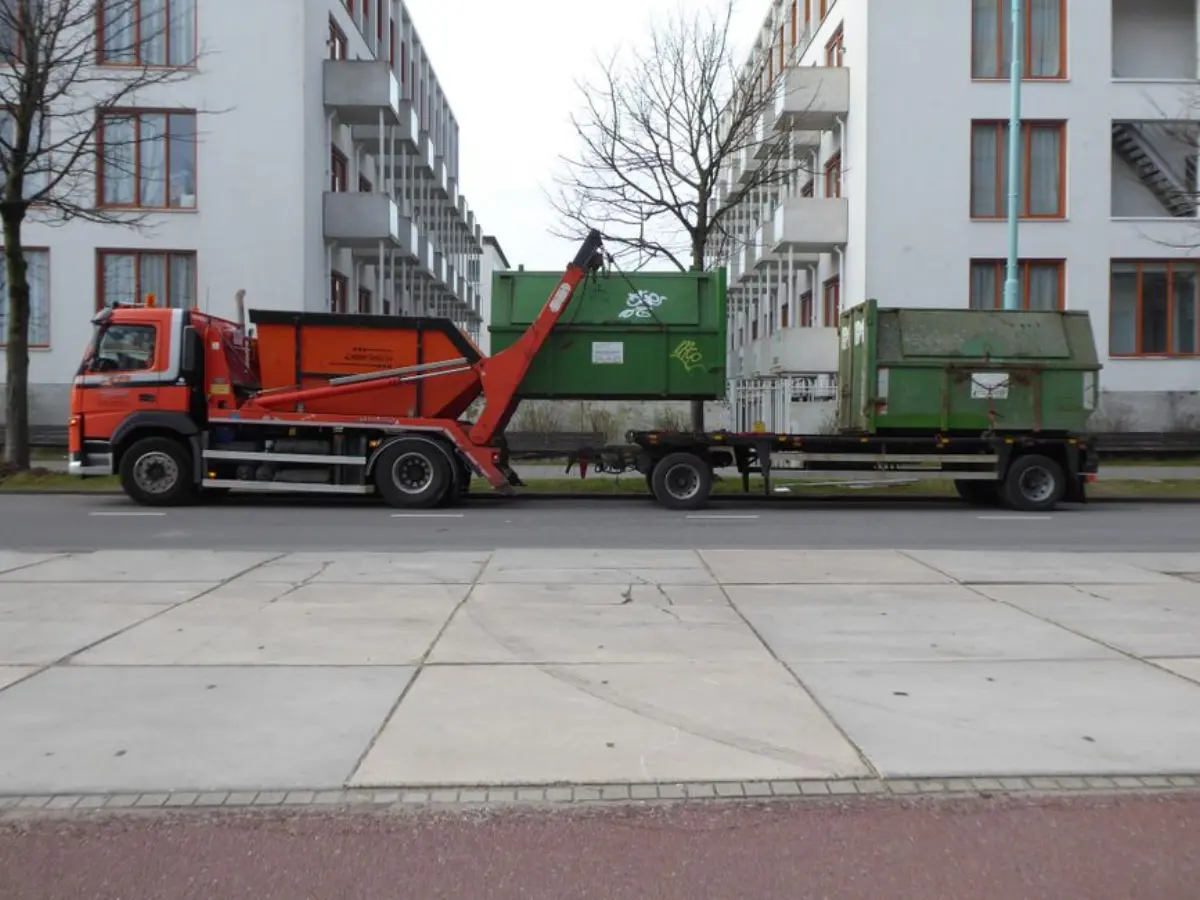
How demolition rubble differs from ordinary waste
Construction rubble is disposed of differently from mixed waste, and it shows in the price as well as in the paperwork. Sorted brick and concrete can be recycled; a mix with insulation, timber and plastics has to be sorted again or landfilled. That is why sorting on site pays off, rather than at the tip.
- Clean rubble. Brick, concrete, ceramics. Most often ends up in a recycling centre as crushed aggregate.
- Reinforced concrete. Needs shearing; the steel is separated and sold separately.
- Timber and metals. Roof structures, frames, pipes. They go to scrap merchants or to energy recovery.
- Soil and excavated material. Deposited at designated places, not on the nearest field.
- Mixed construction waste. Whatever could not be sorted. The dearest item to dispose of.
- Hazardous waste. Asbestos, bitumen felt, tanks, paints and oils. Its own regime, its own documents, its own company.
Which skips are used
| Type | Rough volume | What it suits |
|---|---|---|
| Stackable bath skip | around 3 m3 | Flat renovations, smaller strip-outs, heavy rubble |
| Flatbed skip | around 6 m3 | An ordinary house renovation, a mix of rubble and site waste |
| Large skip with doors | roughly 9 to 13 m3 | Demolition, clearing out, bulky light waste |
Skip volume is not the same as its load capacity. Clean rubble is heavy and a skip is usually full by weight before it is full by volume. Ask about that when you order.
Clearing out and site preparation
Clearing the building happens before demolition and is paid for differently from demolition waste: furniture, appliances, tyres and electronics have their own regime. After the demolition comes the opposite part, namely what is supposed to remain on the plot.
- Clearing a house, flat, cellar, attic, workshop or an estate before demolition.
- Removing hard standings, kerbs, walls, old cesspits and tanks.
- Breaking out foundations and hauling the concrete away when the plot is to carry a new building.
- Backfilling, compacting and levelling the ground.
- Handing over the plot in the agreed state, not in whatever state it ends up.
Frequently asked questions about debris removal
What document should I get about waste disposal?
A document confirming the transfer of waste to an authorised entity, usually together with weighbridge tickets from the landfill or recycling centre. An invoice for haulage on its own proves nothing about where the rubble went.
Can I order just a skip without any demolition?
Yes. A skip delivered on its own plus haulage is a common job, typically during a do-it-yourself renovation. Tell us what will go into it: the price and the type of skip depend on the kind of waste.
Do I need a permit to put a skip on the street?
If the skip stands on public land or takes up a pavement or a parking space, a temporary occupation permit from the municipality is usually needed. On your own land it does not apply. We check it for the specific address.
Related pages
Tell us what needs to come down
The address, a few photos and one sentence about what has to go is enough. We go through the enquiry and pass it to a demolition company that works in your area. If we have no partner there, we say so straight away instead of leaving you waiting.
- Photos from outside and inside say more than a description. A phone camera is fine.
- Tell us whether machinery can reach the building, or whether it has to come down by hand.
- If you suspect asbestos (corrugated cement sheets, old pipe lagging), say so right away.
Prefer the phone? 775 654 443.