Demolition and strip-out works
We tell you what can come down, what the building authority will want for it and where the rubble will go. The enquiry goes to a demolition company that works in your area.
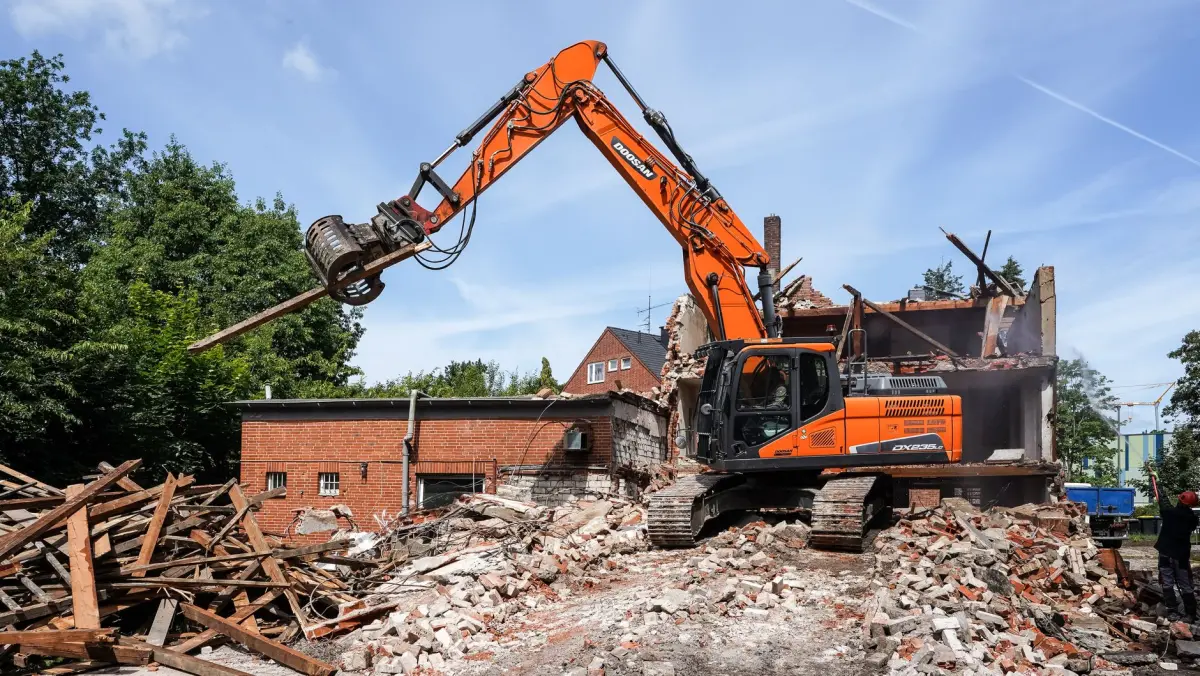
A quote only after a site visit
Volume, structural materials and machine access cannot be judged over the phone. Anyone who tries will change the price later anyway.
Price and date in writing
What is included and what is not (debris, the waste transfer document, levelling the plot) belongs in the quote in black and white.
A company does the work, not us from a desk
We pass the enquiry to a demolition company that works in your area. If we have no partner there, we say so immediately.
What people ask for most often
The size and type of job differ; the paperwork is almost the same for all of them.
Demolition of houses and structures
Family houses, cottages, extensions, garages, farm buildings and parts of buildings. Including foundations and levelling if you want it.
Demolition of houses and structuresInterior demolition works
Bathroom cores, partition walls, openings in load-bearing walls, floors, ceilings. Demolition by hand where machines have no way in.
Strip-out and demolition worksDebris removal and disposal
Skip, haulage, sorting and the waste transfer document. On its own or as part of a demolition.
Debris removal and disposalPermits and documentation
What the building authority wants, what the designer prepares and in what order it has to happen.
Permits and documentationClearing out and site preparation
Clearing the building before demolition, removing hard standings, backfilling and levelling the plot for a new build.
Clearing out and site preparationWhat drives the price
Volume, structure, machine access, disposal site, asbestos. No figures, but honestly.
What drives the price of demolitionWhat demolition takes on paper
Knocking the building down is the shorter part of the job. This is the longer one, and this is where most people get stuck. Four things without which a demolition does not start.
Permit for removing the structure
A building cannot simply be taken down. Under Czech Building Act No. 283/2021 Coll. a permit from the building authority is usually required for a structure that itself needed a permit, and for any structure containing asbestos. The application states the expected start and end of the demolition works, how they will be carried out, which neighbouring plots are affected, and whether the building contains asbestos or asbestos can be expected. We check the exact regime with the building authority the plot falls under.
- Who handles it
- The owner files the application. The demolition documentation is usually prepared by a qualified designer.
- What you end up holding
- A permit with conditions: the deadline for removal, the demolition procedure, and how the plot is to be left afterwards.
Disconnecting the utilities
Electricity, gas, water and sewerage are disconnected by each network operator separately, each at its own pace. While the connections are live, no demolition company will start. This is usually the longest part of the whole job, which is why it is started first.
- Who handles it
- The owner, with a separate request to each network operator.
- What you end up holding
- A disconnection confirmation from every operator. Worth having to hand for the building authority too.
Waste records and the disposal document
Rubble and demolition waste are sorted and handed over to an authorised entity. The transfer document is the only thing that proves where the waste actually went. Without it you hold an invoice for haulage and no evidence that the rubble did not end up in a forest.
- Who handles it
- The company that demolishes and hauls, or the operator of the landfill or recycling centre.
- What you end up holding
- Weighbridge tickets and a document confirming the transfer of waste to an authorised entity.
Asbestos as a separate regime
Asbestos is not part of ordinary demolition. Work with it is notified in advance to the regional public health authority and carried out by a company with the relevant authorisation and equipment. A structure containing asbestos also needs a permit and cannot be removed under the simplified route. We do not do this part ourselves: if we come across asbestos, we handle it separately with an authorised company and tell you before demolition starts.
- Who handles it
- A company authorised for asbestos work, with prior notification filed.
- What you end up holding
- A separate quote for the asbestos and a disposal document for hazardous waste.
How buildings come down
The choice of method is not a matter of taste. It follows from the structure, the access and the surroundings.
| Method | When it is used | What it means for the neighbourhood |
|---|---|---|
| Demolition shears on an excavator | Masonry and reinforced concrete where a controlled sequence is needed | Less vibration than a breaker, material falls in a controlled way, rebar is separated as it goes |
| Hydraulic breaker | Concrete slabs, foundations, floors, road surfaces | Noise and vibration. It is only decent to warn the neighbours beforehand |
| Demolition by hand | Interiors, bathroom cores, partition walls, buildings machines cannot reach | Slower and dearer per hour, but gentle on the surrounding structures and on the neighbours |
| Cutting and dismantling | Steel halls, silos, structures meant for reuse | Cleaner work, part of the material can be recycled or reused |
| Controlled blasting | Tall structures, chimneys, large buildings | Done by specialist companies with their own authorisation. Out of the question for a family house |
What drives the price
You will not find prices here, and that is deliberate. Instead, here is a list of what pushes the price up and down.
- Volume. How many cubic metres of structure have to go. That is why demolition is priced per cubic metre, not per square metre of footprint.
- Structural material. Brick, stone, concrete, reinforced concrete, precast panels. Rebar in concrete makes both the work and the haulage dearer.
- Machine access. Whether an excavator and a skip can reach the building, or whether it comes down by hand and the rubble is carried out.
- Distance and type of disposal site. How far the rubble travels and whether it is sorted or mixed. Mixed waste costs more to dispose of.
There is no price list for demolition, and anyone who sends you one without a site visit is counting on raising the price later. We have written out what goes into the price and what to ask about in a quote.
How it works
You tell us what has to come down
The address, a few photos from outside and inside, rough dimensions and one sentence about what has to go.
- Whose turn it is
- You
- How long it takes
- A few minutes
We ask about what the photos do not show
Machine access, the cellar, the type of floor structures, any suspicion of asbestos, and what is to happen to the plot.
- Whose turn it is
- You and us
- How long it takes
- Usually the same or the next working day
We pass the enquiry to a company in your area
To a demolition company that works there and has the machinery for it. If we have no partner there, we say so instead of keeping you waiting.
- Whose turn it is
- Us and the company
- How long it takes
- Depends on the area
The company visits and gives you a price and a date
In writing, itemised, so you can see what is included. Only then is anything signed.
- Whose turn it is
- Us and the company
- How long it takes
- By arrangement with you
Frequently asked questions
Do I need a permit to demolish a house?
Usually yes. Under Czech Building Act No. 283/2021 Coll. a building cannot simply be taken down. A permit from the building authority is required for a structure that itself needed a permit, and for a structure containing asbestos. Small structures follow a simpler regime. We check the exact scope with the building authority the plot falls under.
Why is demolition priced per cubic metre?
Because both the work and the volume of waste grow with the volume of the structure, not with the footprint. A house with a deep cellar and concrete floors has far more cubic metres than a light building with timber floors on the same footprint.
How long does demolishing a house take?
The demolition of an ordinary family house itself is a matter of days. The paperwork before it (permit, disconnecting utilities) and the clean-up after it (debris removal, levelling the plot) take longer. The company gives you a firm date after the site visit; a guess over the phone is worth nothing.
Do you also take care of debris removal and disposal?
Yes, removing and disposing of the rubble is a normal part of a demolition job. What matters is that the quote says what is included and that you receive a document confirming the transfer of waste to an authorised entity.
What if there is asbestos in the building?
Asbestos follows a separate regime: the work is notified in advance to the regional public health authority and carried out by a company with the relevant authorisation. We do not do it ourselves, we handle it separately with an authorised company. If you suspect asbestos (corrugated cement roofing, old lagging around pipes), write it in the enquiry straight away.
What does the 24 in the name mean?
It is part of the name, not opening hours and not a promise of how quickly anyone arrives. It reads as demolition from start to finish: from the paperwork through the works to the hauled-away rubble. The work is arranged in advance because it needs a permit, disconnected utilities and a skip on site.
Tell us what needs to come down
The address, a few photos and one sentence about what has to go is enough. We go through the enquiry and pass it to a demolition company that works in your area. If we have no partner there, we say so straight away instead of leaving you waiting.
- Photos from outside and inside say more than a description. A phone camera is fine.
- Tell us whether machinery can reach the building, or whether it has to come down by hand.
- If you suspect asbestos (corrugated cement sheets, old pipe lagging), say so right away.
Prefer the phone? 775 654 443.